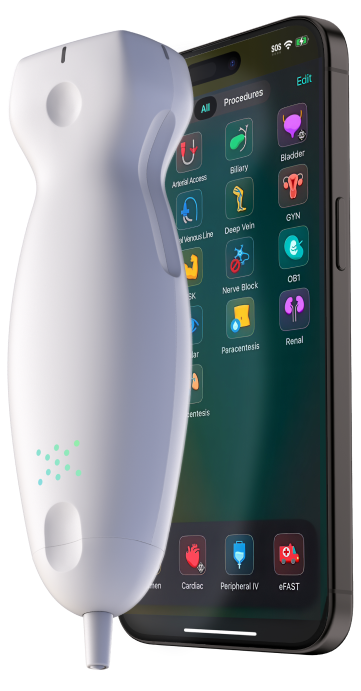
Fort Bend County EMS: The Right Call, Before the Hospital
Most diagnostic answers in emergency medicine come after the hospital doors open. Fort Bend County EMS is moving that moment into the field — and Exo Iris® is how.
Read MoreWhole-body Ultrasound with Real-time AI and QA. Zero Complexity.
SweepAI™

AI that never blinks — auto-labels anatomy, auto-captures key views, and auto-measures precisely, even offline.
Exo U™
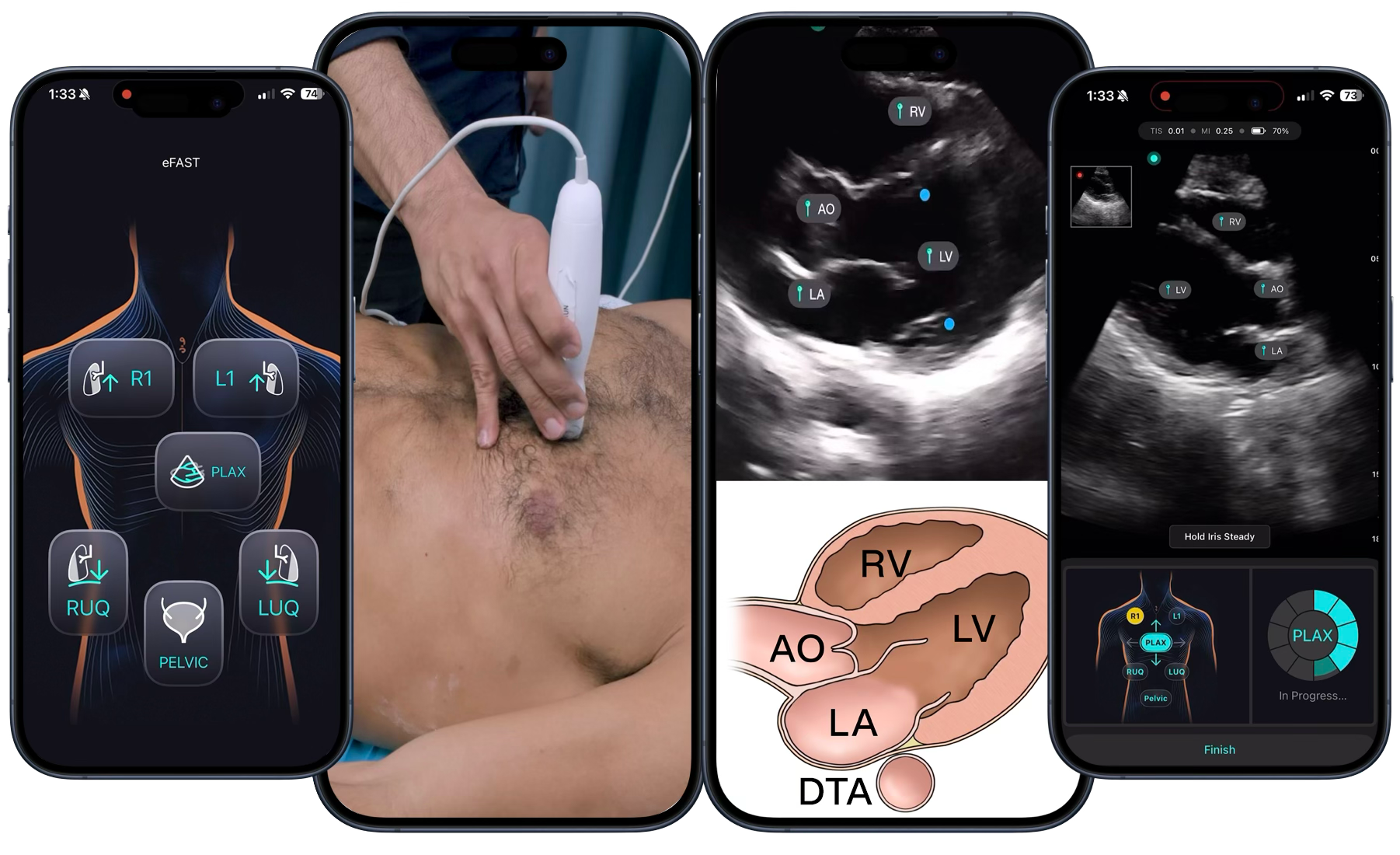
AI that guides probe motion, reveals anatomy, and teaches as you scan — turning every scan into perfect practice.
Exo Works®
Software that makes notes easy, keeps teams connected, and billing accurate.
These videos describe the process of scanning, documenting and billing
Discover Exo Works
Cardiac AI Suite
From heart failure (CHF, HFpEF and HFrEF) to hypertrophy and structural heart changes, Iris delivers FDA-cleared insights at the bedside. Automated EF, chamber size, strain, and wall thickness enable faster, clearer cardiac decisions.

Lung AI Suite
Detect B-lines, effusions, consolidations, and lung pathology — in real time, at the bedside. FDA-cleared lung insights help distinguish edema from effusions and monitor progression without delay.

Fluid Management AI
Real-time IVC collapsibility, bladder volume, and vascular access — assessed in seconds. Automated capture, built-in QA, and quantified insights make fluid management consistent across clinicians.

Population Health AI
Research-ready diagnostic support across care settings — from thyroid cancer risk to hip dysplasia screening — with FDA-cleared imaging tools that power today’s care and advance tomorrow’s discoveries.

Exo Iris
High-Performance Handheld Phased, Curved, Linear Mobile or on a Cart

SweepAI
Guided View Capture Instant Quality Feedback Automated Findings

Exo U
AI Scan Tutor Anatomical Labeling Microlearning Videos

Exo Works
Scan-to-Note Automation QA/Credentialing Reports Vendor Neutral
Most diagnostic answers in emergency medicine come after the hospital doors open. Fort Bend County EMS is moving that moment into the field — and Exo Iris® is how.
Read MoreIn addition to streamlining the use of POCUS at their facilities, Geisinger has also seen an accelerated rate of completed POCUS documentation.
Read MorePublished in the healthcare journal, Diagnotics, the authors of this article shared the following abstract: This work aims to evaluate the performance of a new artificial intelligence tool (Exo AI) to compute the left ventricular ejection fraction (LVEF) in echocardiograms of the apical and parasternal long axis (PLAX) views. We retrospectively gathered echocardiograms from 441 individual patients (70% male, age: 67.3 ± 15.3, weight: 87.7 ± 25.4, BMI: 29.5 ± 7.4) and computed the ejection fraction in each echocardiogram using the ExoAI algorithm. We compared its performance against the ejection fraction from the clinical report. ExoAI achieved a root mean squared error of 7.58% in A2C, 7.45% in A4C, and 7.29% in PLAX, and correlations of 0.79, 0.75, and 0.89, respectively. As for the detection of low EF values (EF < 50%), ExoAI achieved an accuracy of 83% in A2C, 80% in A4C, and 91% in PLAX. Our results suggest that ExoAI effectively estimates the LVEF and it is an effective tool for estimating abnormal ejection fraction values (EF < 50%). Importantly, the PLAX view allows for the estimation of the ejection fraction when it is not feasible to acquire apical views (e.g., in ICU settings where it is not possible to move the patient to obtain an apical scan).
Read More