Fort Bend County EMS: The Right Call, Before the Hospital
When the ambulance is all you have
In the back of an ambulance, the diagnostic toolkit is still thin. A blood glucose reading. A 12-lead EKG. A physical exam. Then judgment. For decades, EMS crews have made life-or-death calls with exactly that — and little else.
The skill was never the question. The tools were. Dr. Joseph Gill, MD, Medical Director of Fort Bend County EMS and Galena Park Fire Department, has spent years trying to close that gap. He’s trained hundreds of clinicians across multiple organizations. And he’s watched programs fall short for the same reason — no feedback,no visibility, no way to get the right answers into the field when they mattered most.
“The repetitive failure comes from a lack of feedback. It hasn’t been a medical director’s fault. There just hasn’t been a good QA solution.”
He needed a device that could finally meet paramedics and EMTs where they are — with real-time imaging, real-time answers and real confidence at the scene. He found it in Iris.
Yesterday. A trailer in the field.
The right call. In two seconds.
An elderly woman. A trailer in the middle of a field. Congestive heart failure and COPD. Two conditions that can look exactly the same.
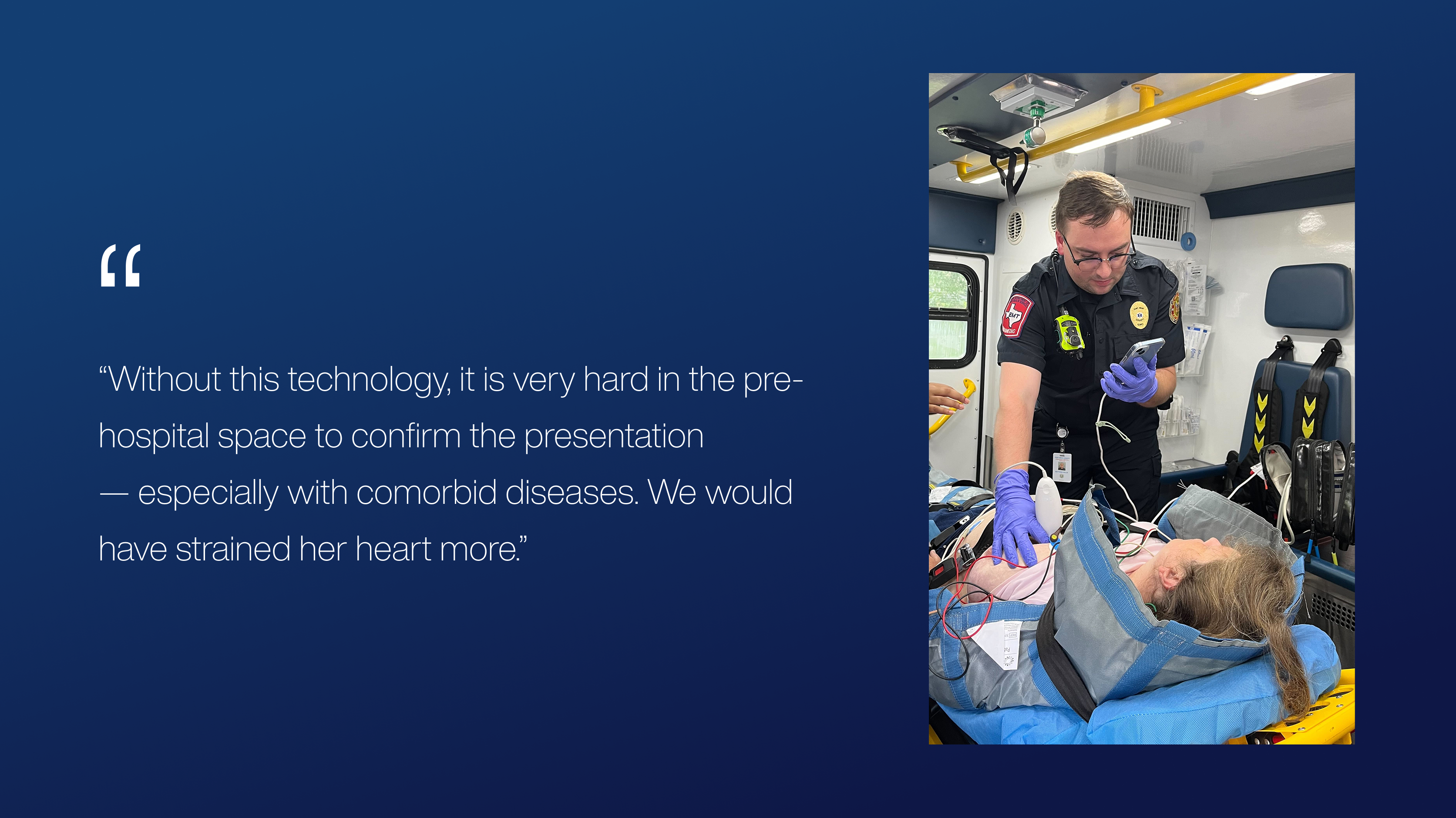
The paramedic called for terbutaline. Dr. Gill picked up the Iris probe. Two seconds on the chest. Bilateral B-lines. Not COPD. Cardiac.
Treatment flipped — nitroglycerin, increased PEEP, no terbutaline. Ten minutes later, she was talking. She walked to the stretcher. No trip to the hospital. No wasted prep on the receiving end. The right treatment. Right there in the field. No Wi-Fi. No signal. Iris never blinked.
The proof a family needed.
Not every win shows up in vitals. A middle-aged man was found at home in cardiac arrest by his wife. The crew did everything right. The EKG showed a flat line. A flat line on a screen can still feel unreal.
His wife was distraught. She still begged for transport — just in case. Dr. Gill asked if she wanted to see. She said yes. He showed her cardiac standstill on Iris — the heart, still. Visible proof. Something she could finally understand.
A tragic moment, handled with clarity and compassion.
“We’re not just telling you. We’re showing you. That’s the humanity in medicine.”
Why Fort Bend chose Iris
Dr. Gill chose Iris because it works in environments that break everything else.
• Image quality on par with cart-based systems — in a device that fits in a pocket.
• AI and education tools that build novice confidence fast — real-time guidance, automated QA and immediate feedback that turns every scan into a learning moment
• Built for the field, not just the hospital — a ruggedized, one-probe design that survives the demands of EMS and fire.
• QA and credentialing built in — fast feedback, no double charting, yes-or-no answers that matter to a medical director.
• Fastest deployment of any portable ultrasound platform — across more than a decade of hands-on experience with every major device, Iris went from first training to first field use in under a month.
The Rollout
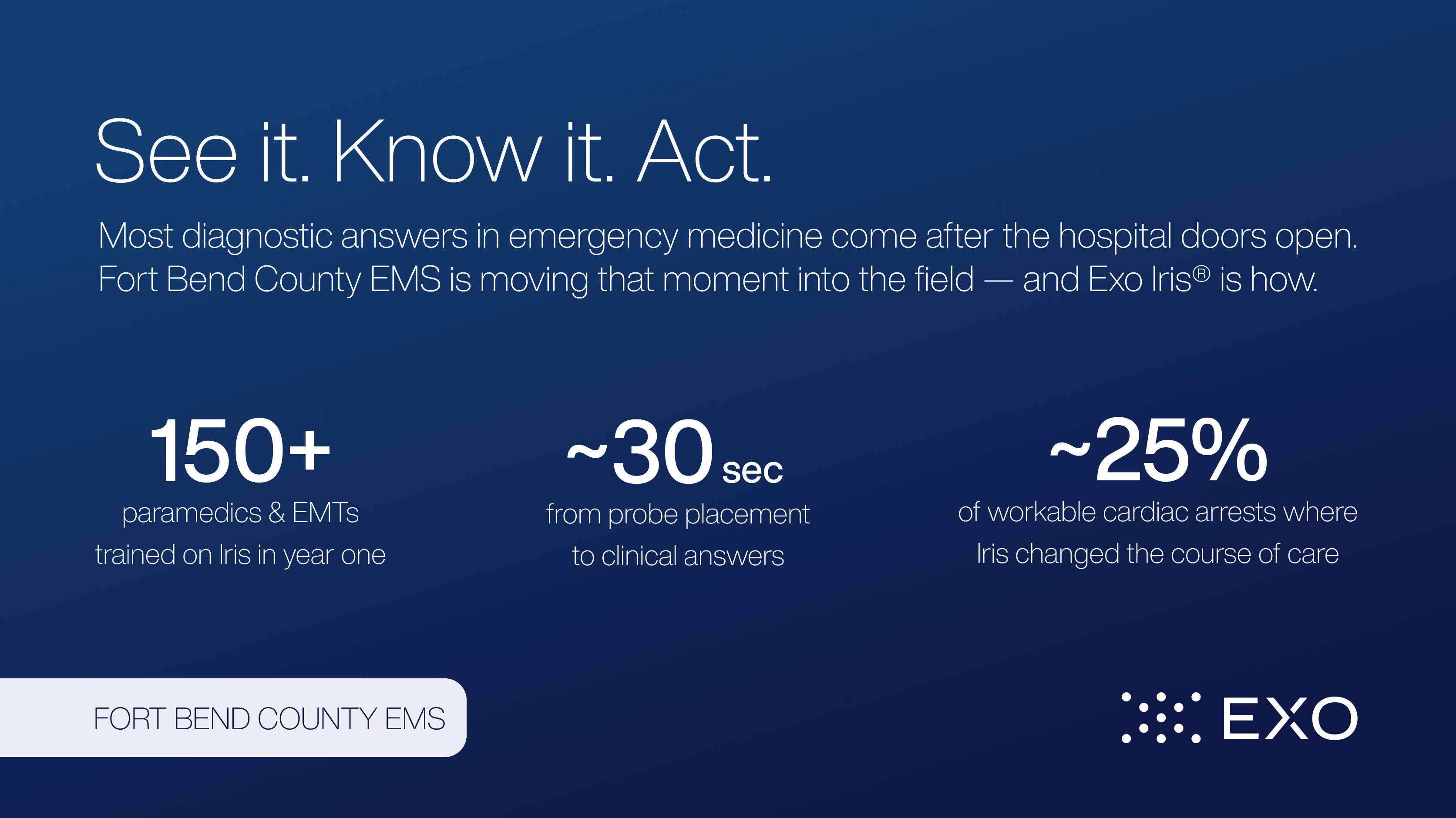
Iris is already on every battalion chief vehicle. Full fleet deployment — ambulances, squad medics, lieutenants and medical director vehicles — is underway, phased by credentialing level. More than 150 users will train in year one.
Adoption has been organic: most cardiac arrests now arrive with an ultrasound image before the call even comes in.
Fort Bend EMS
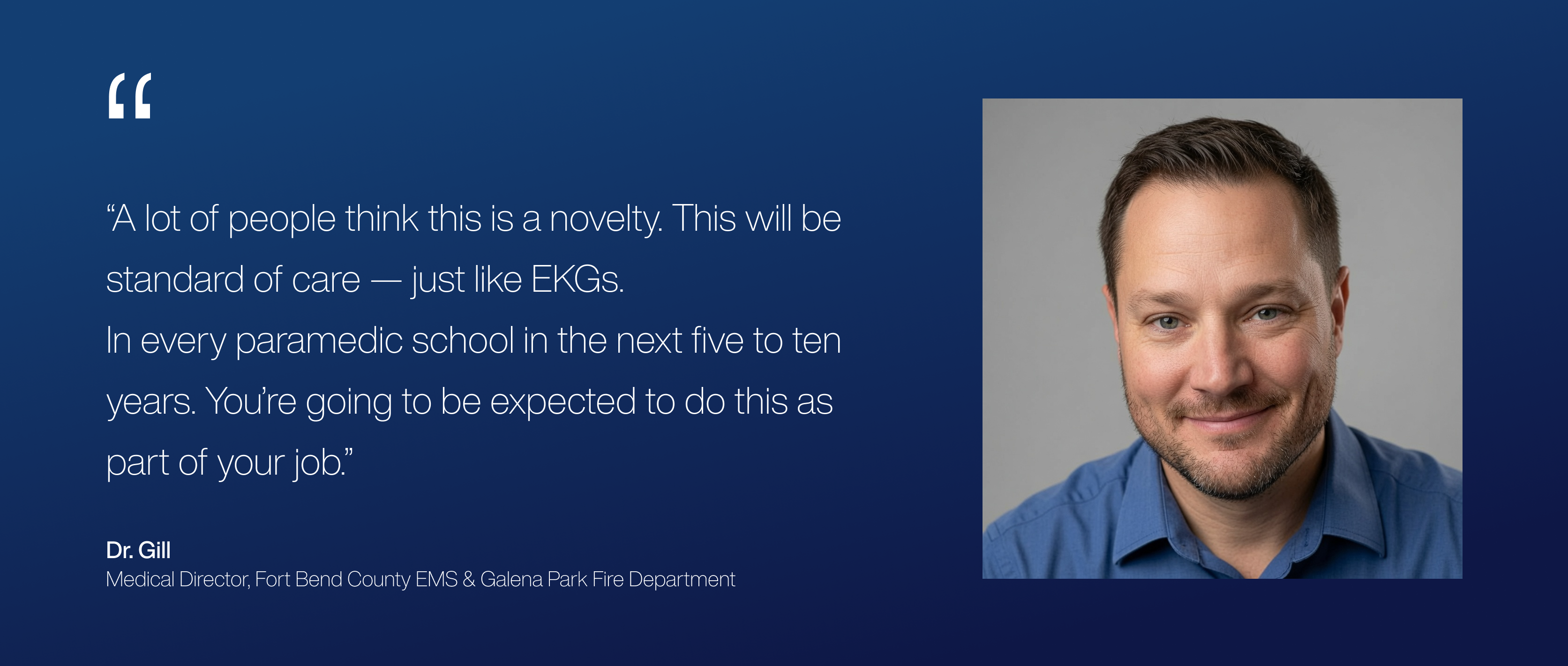
Fort Bend County EMS serves one of the fastest-growing counties in the United States, covering more than 900 square miles of suburban and rural terrain in the greater Houston area. The department responds to tens of thousands of calls annually. Dr. Joseph Gill serves as Medical Director and is an Assistant Professor of Emergency Medicine at McGovern Medical School at UTHealth Houston.